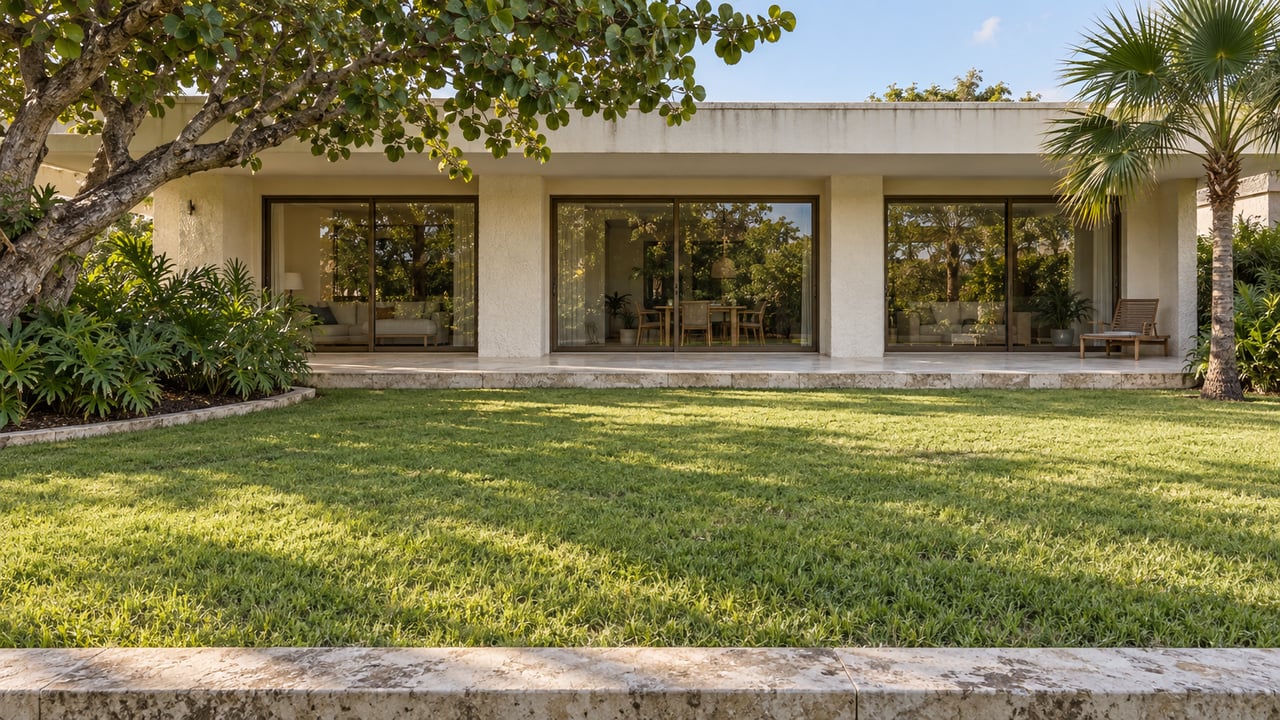
In Coconut Grove, the Priciest Square Foot This Fall Belongs to a 1969 House
October 15, 2026
October 15, 2026
"There are two speed markets racing at the same time," Mint Developers CEO Daniel Berman told Miami Today in early October. He described a top end where new construction has strong demand and very little supply. In the older homes, he said, there are more options, sales take longer and buyers have room to negotiate.
That split is real. The Grove's 2026 sales show something more useful for a buyer comparing neighborhoods, though. At the top of the market, the house is often the least important thing being priced. The lot and the water frontage set the number. Once you see that, the per-square-foot comparisons used to judge a Grove listing start to read differently.
In the week of September 28 to October 4, 2026, a five-bedroom house at 3373 Poinciana Avenue in Four Way Lodge Estates went under contract, asking $17.4 million. The Real Deal reported that it was built in 1969 and has 4,280 square feet. The ask works out to $4,065 per square foot.
That same week, 12 single-family homes asking $4 million or more went under contract across Miami-Dade. According to the same weekly tally, they averaged $9.3 million and $2,040 per square foot. So the Poinciana ask was roughly double the countywide luxury average, for a house that is more than half a century old.
The lot explains it. The house sits on 50,000 square feet with a 22,000-square-foot mangrove preserve and 60 feet of water frontage. The house is the small part of the deal. Spread over the land, the asking price comes to about $348 per square foot of lot. That is the figure a buyer of this kind of property is effectively weighing.
The property has a local history too. The Real Deal tied the listing to a co-founder of Kaufman Rossin, the accounting firm that worked out of 2699 South Bayshore Drive until 2020. That address is now the construction site of Four Seasons Private Residences Coconut Grove, which is slated for completion in 2028.
Two months earlier, the Miami Herald reported a $22.5 million sale at 4040 Kiaora Street. The home was newly built, sold by its developer, Sabal Development, and sits in lush vegetation about a mile inland from Biscayne Bay. The Herald called it a neighborhood record, but a qualified one: the most expensive non-waterfront home ever sold in Coconut Grove.
The qualifier is the point. The Grove's top inland sale in the third quarter, a newly built home sold by its developer, closed at about $2,547 per square foot. By our reading of Q3 data, it took more than a year to sell. The 1969 waterfront house was asking about 60 percent more per square foot.
Kiaora's buyer paid for new construction on land without water. The Poinciana buyer is paying for water and acreage, with a house attached. Compare the two homes per square foot and you are comparing two different products.
| Property | Built | Setting | Price | Per square foot |
|---|---|---|---|---|
| 3373 Poinciana Ave | 1969 | Waterfront, 50,000 sf lot, mangrove preserve | $17.4M asking, under contract Sept.–Oct. 2026 | About $4,065 asking |
| 4040 Kiaora St | New construction | About a mile inland | $22.5M sold, summer 2026 | About $2,547 |
| 3631 Florida Ave | Not reported | Two-bedroom, one-bath home | $1.05M sold, Q3 2026 | About $698 |
From the bottom row to the top, the per-square-foot figure rises nearly sixfold. Water frontage, lot size and preserved land account for most of that spread, and the houses themselves for much less of it.
That spread is why this fall's headline numbers need care. In Q3 2026, July through September, the Grove recorded 57 single-family closings by our count, up from 37 in Q3 2025. The median sale price rose about 22 percent to $2.8 million. The median price per square foot rose about 30 percent to $1,245.
Part of that jump comes from which homes sold. Eight of the quarter's closings were new construction, compared with three a year earlier, and the $22.5 million Kiaora sale is in the set. When more of the sales are big new houses or prime parcels, the medians rise even if no individual home gained value. The quarterly figures cannot separate that change in mix from true appreciation.
The Grove is also running against the county trend. Miami-Dade single-family sales fell 3.1% year over year in August 2026 to 858 transactions, while the county median rose 3.82% to $680,000. MIAMI REALTORS counted 194 sales of $10 million or more through August, already 14.1% above the total for all of 2025. The county is selling fewer homes overall and more at the very top. Neighborhoods with the most trophy parcels report the strongest averages.
The clearest evidence that Grove buyers are paying for land comes from deals where the house barely figures in. The Real Deal reported that a waterfront home at 3575 Battersea Road sold off market over the summer. Sources put the price between $80 million and $100 million, and no deed had been recorded at the time of the report. The house was built in 2015, has nearly 11,000 square feet and sits on 0.9 acres. The seller also controls the quarter-acre vacant lot next door through a separate entity.
The same report described a buyer who spent a combined $173 million on two Grove waterfront estates last winter. That buyer then paid nearly $15 million for the non-waterfront house next to one of them, a practice the trade press has started calling "landmaxxing." A year earlier, a 7.3-acre property off Douglas Road, beside The Kampong botanical garden, traded for more than $100 million. In The Real Deal's words, waterfront homes on large lots are in demand and "inventory is scarce."
When a $15 million inland house is bought to buffer a waterfront estate, its price reflects what it does for the land next door. Whatever is built on it matters less. Those trades become comps too, and they push up the per-square-foot figures for nearby inland homes without telling a typical buyer much.
Berman's "buyer's market" comment applies to the other end of the Grove. He told Miami Today that higher rates weigh more on the lower end, where buyers "are getting scared," while cash buyers at the top are largely unaffected. In August 2026, cash purchases made up 37.8% of closed sales countywide and 50.5% of existing condo sales, according to MIAMI REALTORS.
The Grove's own numbers point the same way. In Q3 2026, Grove sellers received a median 93.9% of their final asking price. As of October 4, 2026, there were 76 single-family listings with a median ask of $4.225 million, 23 homes under contract and roughly four months of supply. Those listings and the quarter's closings are different sets of homes. The gap between a $4.225 million median ask and a $2.8 million median sale shows where current inventory is priced, not what sellers have accepted.
For a buyer looking at an older inland home, that changes how to judge a listing. When the house is the main thing being sold, its condition, age and layout carry real weight in the price, and slower sales in that segment give a buyer time to raise those points. On a waterfront acre, the same points barely move the number. A 1969 house on Poinciana asked $4,065 per square foot, and its age did not hold the price down.
Questions that separate the two kinds of Grove comps:
Did Coconut Grove home values rise 30% in 2026? The median price per square foot rose about 30% in Q3 2026 compared with Q3 2025. New-construction closings also rose from three to eight, and a $22.5 million inland record closed during the quarter. Both push the median up without any single home gaining value.
Is new construction selling fastest in the Grove? Developers describe strong demand and thin supply for new product at the top. Still, the Grove's record non-waterfront sale, a newly built home on Kiaora Street, took more than a year to close.
Why would an older house cost more per square foot than a new one? In the Poinciana case, the 1969 house came with 50,000 square feet of land, a mangrove preserve and 60 feet of water frontage. The price follows those features, and the house's square footage is too small a share of the property to explain it.
The DeFortuna Group reads Coconut Grove comps lot by lot: frontage, parcel size and what the buyer next door is assembling. A per-square-foot average can't show those. To see how your property or shortlist compares on that basis, The DeFortuna Group invites you to schedule a private consultation.
Stay up to date on the latest real estate trends.
Etiam non quam lacus suspendisse faucibus interdum. Orci ac auctor augue mauris augue neque. Bibendum at varius vel pharetra. Viverra orci sagittis eu volutpat.