What to Know About a Coral Gables Four-Point Inspection
September 17, 2026
September 17, 2026
The home inspection came back clean. Roof sound, plumbing fine, no structural surprises in a 1928 Mediterranean Revival two blocks off Alhambra Circle. Then, three weeks from closing, the file stalled. Not because of anything the buyer's inspector found. Because of a report nobody had ordered yet.
That report is the four-point inspection, and in Coral Gables it is doing more work than most buyers, and more than a few sellers, realize until it shows up late in a transaction. It is a separate, narrower document from the standard home inspection, built for one audience only: the insurance carrier deciding whether to write a policy at all. Citizens Property Insurance, Florida's insurer of last resort, requires one on every property owner, dwelling, and mobile home application for a home more than 20 years old, and it checks exactly four systems: roof, electrical, plumbing, and HVAC. Given that Coral Gables was platted and largely built out under George Merrick's Mediterranean Revival ordinance in the 1920s through the 1950s, that 20-year threshold catches nearly every single-family listing in the city.
Here is the part that runs against intuition. Age does not penalize a house here the way most buyers assume it will. It depends entirely on what the roof is made of.
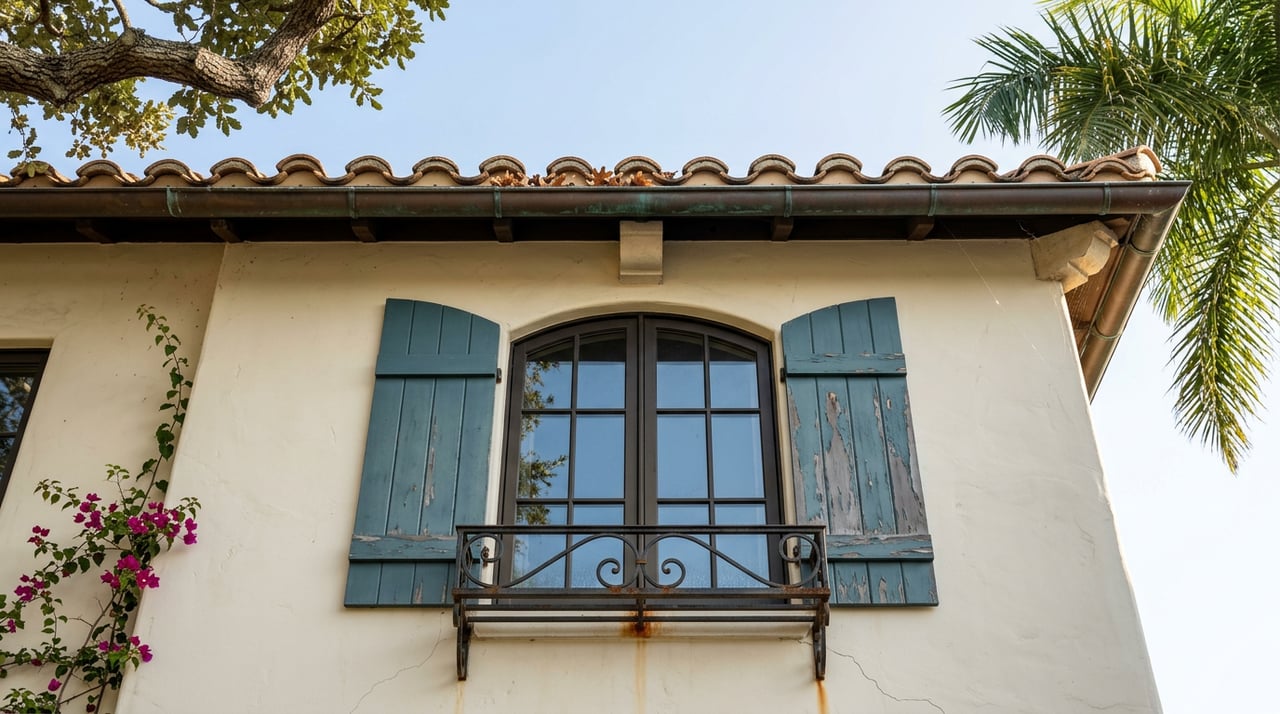
Citizens draws a hard line between roof materials, and it is generous to the very material Merrick's ordinance put on most Gables roofs. Shingle roofs older than 25 years need documentation showing at least five years of remaining useful life before a carrier will write or renew coverage. Tile, slate, concrete, and metal roofs get double that runway: 50 years before the same documentation requirement kicks in.
A well-maintained barrel tile roof from the 1930s can clear underwriting more easily than a 15-year-old shingle roof on a newer build two streets over. That is the opposite of what most buyers expect walking into a nine-decade-old house, and it is worth knowing before anyone assumes an older roof is automatically a red flag or a bargaining chip.
The catch is the word maintained. A tile roof's age exemption only holds if the underlayment and the roof deck beneath the tile have been kept up, and that is where Coral Gables' other defining feature works against the house.
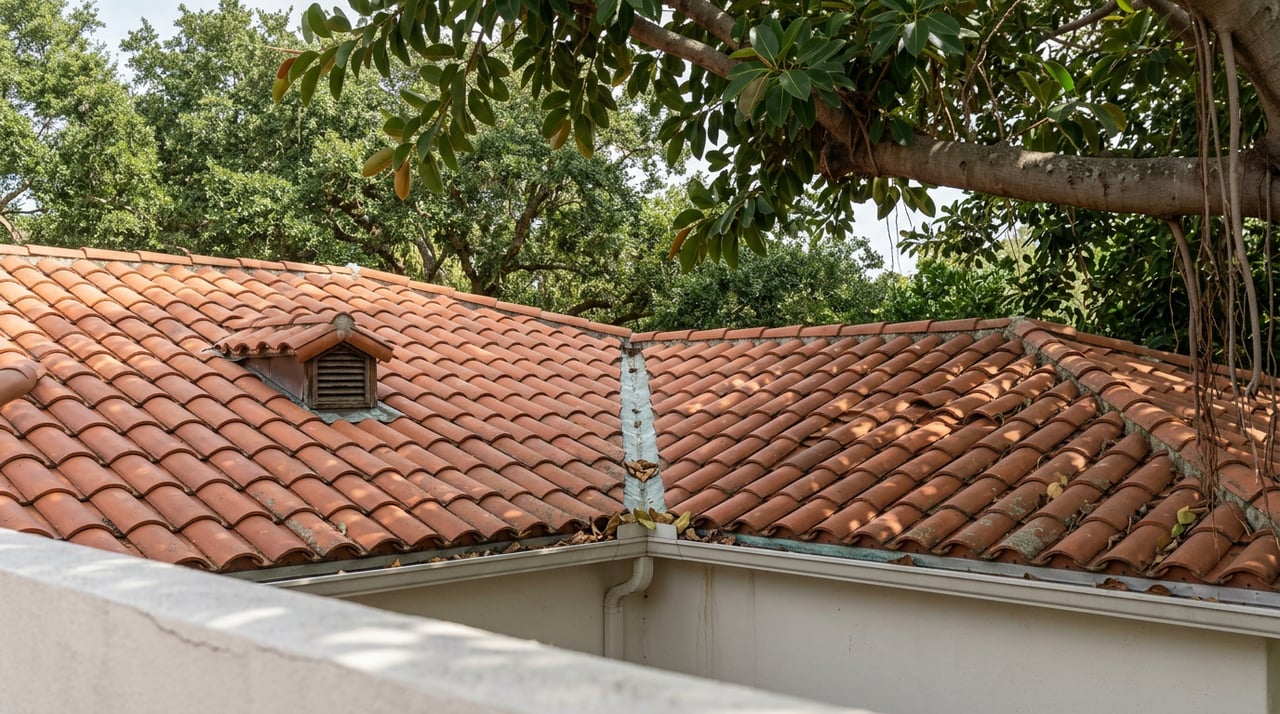
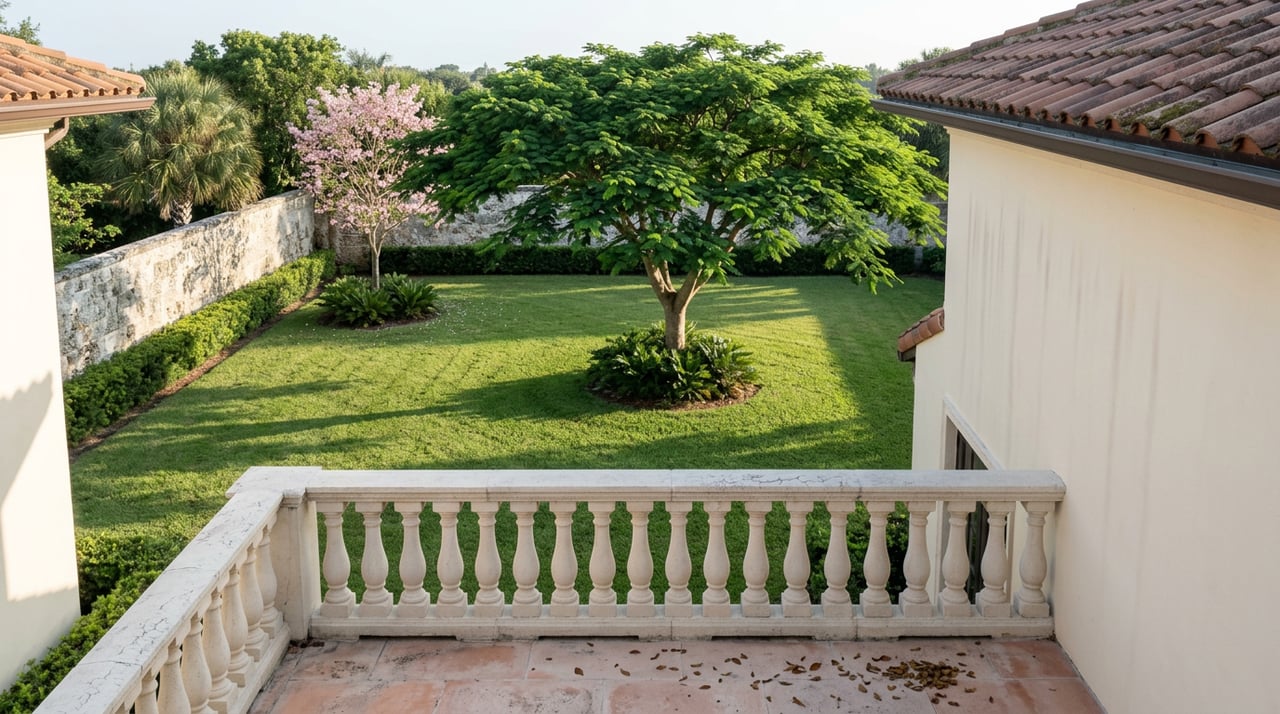
The oak, banyan, and ficus canopy that makes the Gables what it is also produces roof and drainage failures that inspectors describe as distinct to this part of Miami-Dade. Leaf and seed debris packs into roof valleys and gutters, accelerating tile and shingle deterioration in ways a bare-roof house never experiences. Below ground, mature banyan root systems have documented histories of pushing into foundation perimeters, cracking slabs, and blocking underground drain lines that were never engineered to handle root pressure from a hundred-year-old tree.
None of this shows up on a listing photo. It shows up on a four-point report as unexplained roof deterioration or drainage anomalies, and it is the reason a home with a technically young enough roof can still stall in underwriting. If a seller has had the canopy professionally managed, root barriers installed, or drainage rerouted around a mature tree, that maintenance history is worth documenting before a buyer's inspector ever sets foot on the property.
Homes built between 1920 and 1950, which describes a meaningful share of the Gables' housing stock, often carry original electrical infrastructure that predates every modern safety expectation: cloth-insulated conductors, knob-and-tube wiring, or early ungrounded circuits sealed behind coral rock and hand-troweled plaster walls. Panel brands from later decades, including Federal Pacific Electric's Stab-Lok line and Zinsco panels, are flagged on sight by four-point inspectors because of documented failure rates, and a flagged panel is one of the more common reasons a carrier declines to write coverage rather than simply pricing around it.
Replacing a standard panel typically runs $1,500 to $3,500. A home that needs a 200-amp service upgrade to support modern HVAC and appliance loads can run $2,500 to $5,000. Either way, once the panel is swapped, the file needs a fresh four-point report before it can go back to the carrier, which means this is not a same-week fix if it surfaces during a pending sale.
Coral Gables' historic-district and Mediterranean-ordinance rules protect the aesthetic that makes the city distinct, and they attach a real cost the first time a home files a storm claim. The FL Insurance guide says post-loss repairs must meet modern code and Coral Gables' historic-district rules, which is why ordinance-or-law coverage is sized generously on historic homes.
The materials themselves complicate the math further. Barrel tile, hand-applied plaster, coral rock, and custom millwork price out as artisan work, not tract-home replacement cost, which is why an accurate dwelling limit here has to be built from the home's actual materials rather than a tax-appraisal estimate. And debris removal has its own ceiling: most policies cap what they will pay to haul away storm debris, and a single mature oak or banyan can exceed that sub-limit on its own.
Flood coverage is excluded from every standard homeowners policy in Florida, four-point inspection or not. FEMA-designated AE and VE zones cover much of Cocoplum, Gables Estates, and the streets closest to the Coral Gables Waterway. Buyers outside those mapped zones sometimes skip the conversation entirely, but it is worth having anyway. Nationally, roughly one in four flood claims comes from properties outside high-risk flood zones, which is the kind of statistic that argues for a quote even when a lender isn't requiring one.
None of this friction is happening against a worsening backdrop. Florida's homeowners insurance market moved into genuine stabilization heading into 2026, following the 2022 and 2023 tort reforms, which Latent Insure says eliminated one-way attorney fees and restricted assignment-of-benefits claims. Citizens approved its first statewide rate decrease since 2015 for 2026, an average reduction of 8.7 percent, and Miami-Dade County is seeing one of the steepest local cuts in the state at roughly 14 percent for the county's Citizens policyholders. More than a dozen new private carriers have entered Florida since the reforms took hold, giving buyers who get flagged on a four-point more places to shop than they had two years ago.
That matters for how a Gables transaction should actually be timed. The insurance gate is real, but it is a documentation problem, not a pricing crisis. A roof certification, an electrical panel report, or proof of canopy maintenance ordered before a home hits the market resolves most of what would otherwise surface as a stall three weeks from closing.
Before listing or writing an offer on a pre-1970s Coral Gables home, it's worth having on hand:
Does a four-point inspection replace the buyer's home inspection? No. A four-point is a narrower report built specifically for insurance underwriting and covers only roof, electrical, plumbing, and HVAC. A buyer should still order a full home inspection for everything else, from foundation to windows to structural components.
What happens if a roof fails the four-point? A roof failure can affect the insurance process and may delay closing.
Is flood insurance worth getting outside a mapped flood zone? Given that flood is excluded from every standard homeowners policy and a meaningful share of claims nationally originate outside high-risk zones, most brokers who work in the Gables recommend at least pricing a policy, even for homes that sit outside the FEMA AE and VE boundaries near the Waterway.
A property's charm and its insurability are two different evaluations, and in Coral Gables they don't always agree. If you're weighing a purchase or preparing to list a historic Gables home, The DeFortuna Group can walk through what a specific property's age, roof, and canopy history mean for a clean path to closing. Schedule a private consultation to start that conversation before it becomes a closing-week surprise.
This article is general information, not legal, tax or financial advice. Consult a qualified professional about your situation.
Stay up to date on the latest real estate trends.

Etiam non quam lacus suspendisse faucibus interdum. Orci ac auctor augue mauris augue neque. Bibendum at varius vel pharetra. Viverra orci sagittis eu volutpat.